

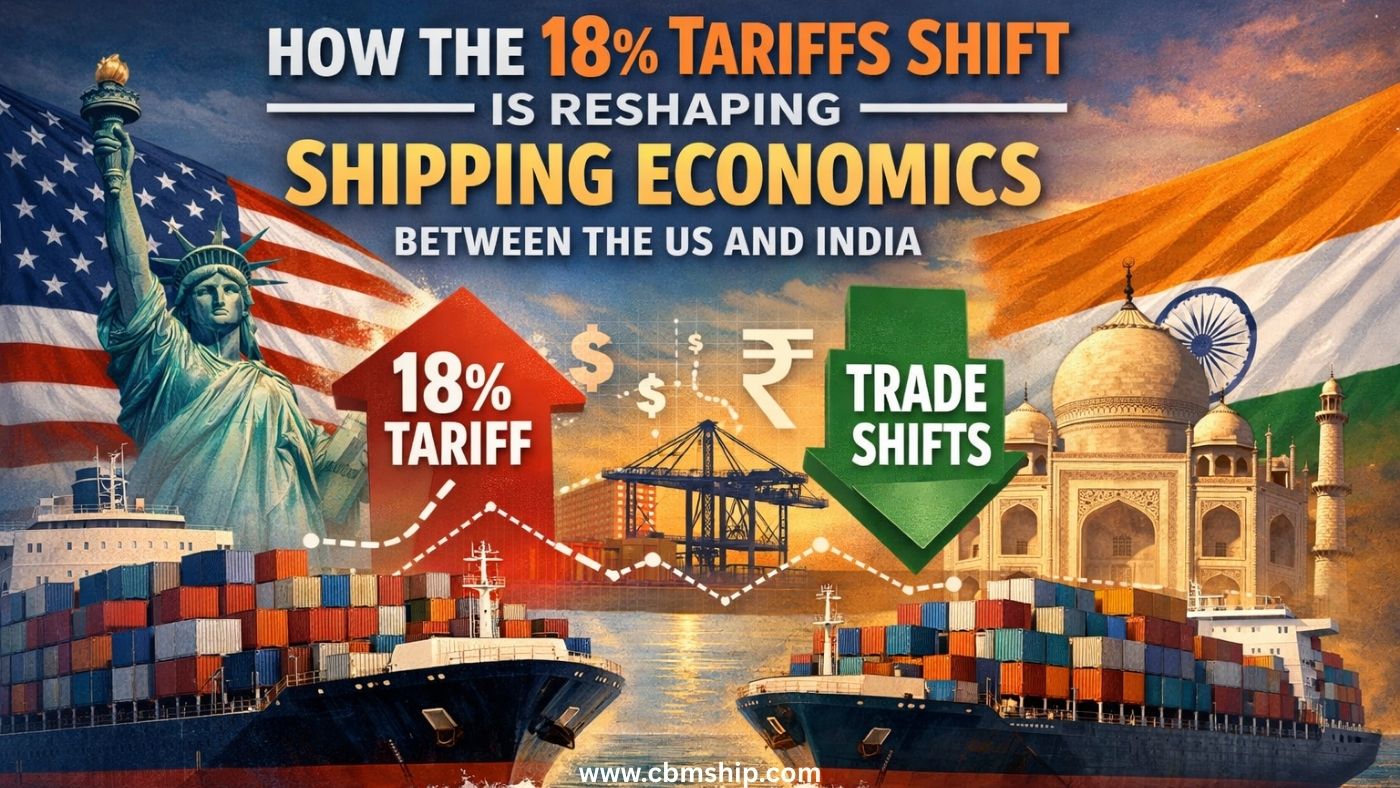
How the 18% Trade Reset Is Reshaping Shipping Economics Between the US and India
The February 2026 decision by the United States to standardize Indian import Tariffs at an 18% ceiling marks a major turning point in cross-border logistics. This reform directly benefits Amazon FBA sellers, Indian exporters and freight forwarders by replacing uncertainty with predictability.
For years, unstable trade policy forced businesses to operate defensively. Companies rushed shipments, overstocked warehouses and absorbed sudden cost shocks. With a fixed framework, logistics planning becomes measurable. Instead of reacting to policy fear, businesses now build structured freight systems.
For official background on how duty policy influences trade flow, the U.S. Customs and Border Protection agency provides a current overview.
Why Predictability Changes Trade Behavior
Unstable Tariffs historically acted like hidden taxes on logistics decisions. Importers shipped early to avoid increases or delayed orders when policy signals were unclear. This behavior distorted inventory planning and inflated operational overhead.
A capped system removes panic-driven decisions. Businesses can calculate long-term landed cost and synchronize procurement with demand forecasting. Freight becomes engineered infrastructure rather than emergency reaction.
Predictability is not just comfort — it is operational leverage.
Operational Advantages for Amazon FBA Sellers
Marketplace sellers depend on timing accuracy. Inventory delays or unexpected cost spikes damage performance metrics. The new framework gives Amazon FBA merchants a stable planning environment.
Reliable Inventory Cycles
Sellers can align replenishment with actual sales patterns instead of policy uncertainty.
Margin Protection
Forecastable duty exposure protects pricing strategy and reduces profit volatility.
Healthier Cash Rotation
Less emergency freight means capital moves faster through the system.
Easier Market Entry
New Amazon FBA businesses face lower psychological risk entering global trade.
Structured logistics supports marketplace consistency.
Export Stability for Indian Manufacturers
Indian exporters gain buyer confidence under predictable tariffs. U.S. importers are more willing to commit to recurring purchase agreements because duty exposure is measurable.
Factories benefit from smoother production planning. Instead of feast-or-famine order cycles, exporters operate within steady demand. Companies serving Amazon FBA supply chains especially benefit from repeat shipment schedules that support continuous manufacturing.
Stability transforms exporters into long-term strategic partners.
Freight Forwarder Efficiency Gains
Freight networks perform best when cargo flows rhythmically. Sudden policy shifts previously created congestion spikes followed by idle capacity. A stable ceiling restores balance.
Forwarders now gain:
Consistent container allocation
Repeatable routing schedules
Reduced emergency shipments
Long-term contract confidence
Predictable tariffs support operational discipline. Shipping becomes a managed pipeline rather than a reactive scramble.
Commodity Case Study: Wire Hangers
Wire hangers represent thin-margin goods where logistics efficiency defines profitability. In the past, unpredictable tariffs forced importers to overstock as a safety buffer.
The new framework enables smaller, recurring shipments. Warehousing pressure declines and cash turns faster. Exporters schedule production with greater confidence. Freight partners design repeatable routing templates.
Even low-value products gain measurable efficiency when duty exposure stabilizes.
Financial Effects Beyond Shipping
Trade policy stability influences financial ecosystems connected to logistics.
Insurance providers reduce uncertainty premiums. Banks view predictable duty structures as margin protection, improving access to working capital. Importers experience smoother credit evaluation.
Predictable tariffs also justify infrastructure investment. Logistics firms modernize tracking systems and warehouse automation because cargo volume becomes forecastable.
Efficiency expands beyond freight invoices.
Compliance Discipline in a Fixed System
A stable environment raises documentation expectations. When rules stop moving, mistakes stand out more clearly. Customs authorities enforce classification accuracy with greater scrutiny.
Core Documentation Priorities
Correct harmonized codes
Transparent origin records
Accurate cargo valuation
Integrated duty tracking
Businesses that embed compliance into logistics workflows move cargo faster and protect margins.
Precision becomes a competitive edge.
Logistics Engineering After the Reset
The 2026 shift encourages structured logistics design. Shipping intervals standardize. Warehousing rotates predictably. Insurance modeling improves.
Instead of building buffers against sudden policy shocks, companies invest in streamlined freight pipelines. Amazon FBA sellers benefit directly from engineered logistics that stabilize marketplace performance.
Freight evolves into a strategic asset.
Role of Professional Freight Coordinators
Regulatory clarity creates opportunity only when execution is strong. Freight coordinators translate policy into operational systems.
They manage paperwork alignment, routing optimization and compliance architecture. Predictable Tariffs allow coordinators to build repeatable shipping frameworks that protect importer margins.
Small businesses gain access to professional logistics discipline without building internal departments.
Investment Confidence and Business Expansion
A stable trade environment encourages companies to think beyond short-term survival and toward expansion. When regulatory costs stop shifting unpredictably, businesses gain the confidence to invest in infrastructure, staffing and technology. Importers are more willing to scale operations because they can model future expenses with clarity. This confidence reduces hesitation and accelerates decision-making at the executive level.
Expansion becomes a calculated strategy rather than a risky leap. Warehouses upgrade capacity, exporters improve production efficiency and logistics providers expand service networks. Over time, these investments compound into stronger trade ecosystems. Stability does not just protect margins — it creates conditions where growth becomes intentional and sustainable.
Strengthening Long-Term Trade Relationships
Predictable rules foster trust between international partners. Buyers and suppliers operate more transparently when neither side fears sudden policy shocks. This trust encourages longer contracts, deeper collaboration and shared planning. Instead of negotiating defensively, companies focus on mutual efficiency and coordinated scheduling.
Stronger relationships also reduce operational friction. When partners trust the framework, they share data, align forecasts and synchronize shipping cycles. This cooperation improves reliability across the supply chain. The result is a quieter but more resilient trade network built on continuity rather than reaction.
CBM Ship Freight Services
CBM Ship connects Indian exporters with U.S. import networks through structured logistics workflows. The company focuses on cost efficiency and documentation simplification, helping smaller importers operate confidently in global trade.Their repeatable shipping model aligns with the 18% ceiling, enabling predictable inventory movement.
Website:
Strategic Outlook for Bilateral Trade
The reset signals a cooperative phase in U.S.–India commerce. Analysts expect negotiation-driven adjustments rather than escalation. Predictable tariffs encourage stable cargo flow, strengthening logistics infrastructure on both sides.
Businesses that align planning with regulatory clarity gain long-term resilience.
Continuity supports growth.
Conclusion
The 18% ceiling converts uncertainty into structure. Stable Tariffs allow exporters, freight forwarders and Amazon FBA sellers to operate inside predictable systems. Margins stabilize, inventory cycles improve and logistics becomes engineered rather than improvised.
Trade thrives when planning replaces panic. Companies that integrate compliance, analytics and disciplined freight design transform shipping into competitive advantage.
Predictability is now the foundation of modern supply chains.
FAQs
1. What changed in 2026?
The U.S. capped many Indian import duties at an 18% ceiling.
2. Who benefits most?
Exporters, freight forwarders and Amazon FBA sellers gain planning clarity.
3. Does this remove duties completely?
No. It stabilizes the framework rather than eliminating charges.
4. Why does stability matter for small goods?
Products like wire hangers depend on tight margins and benefit from predictable costs.
5. Should companies adjust compliance systems?
Yes. Fixed rules increase expectations for documentation accuracy.
Comments are closed